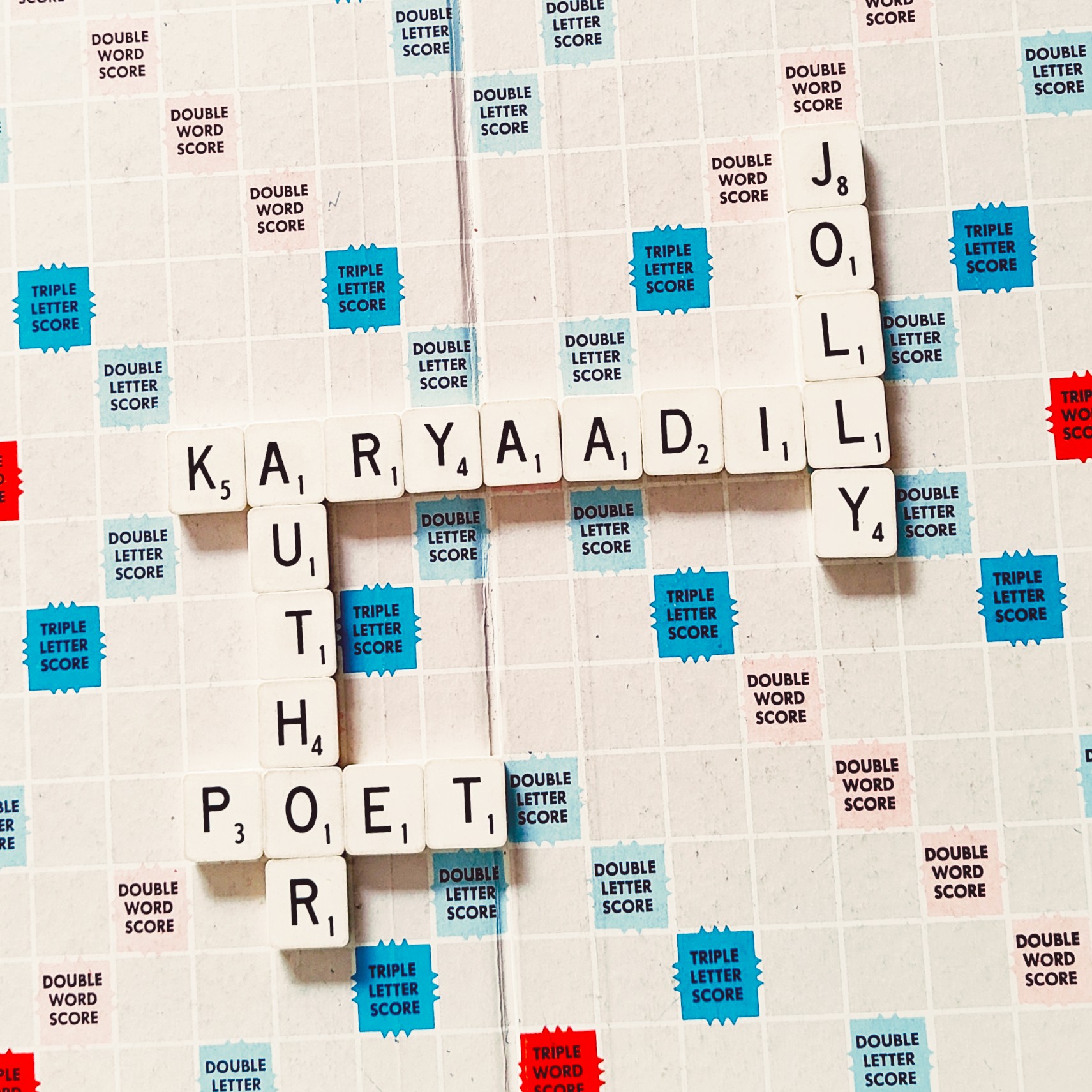
JOLLY KARYAADIL
AUTHOR
Novelist in pre-publication stage.
Coming soon –
SONGS OF THE ANKLETS
A historical epic novel set in colonial India featuring
- a curse
- a forbidden love
- a country in flames
About SONGS OF THE ANKLETS
A family curse. A forbidden love. A nation in flames.
In 1940s India, on the cusp of freedom, Shankaran, a progressive Brahmin, and Uma, a girl from a lower caste, are hurtled on to separate, harrowing journeys across a country fighting to reclaim itself.
In Bombay, Shankaran is forged in the fires of the independence movement, his spirit tempered by imprisonment and spiritual seeking. Exiled to Calcutta, Uma endures a cold marriage, devastating betrayal, and widowhood—only to discover her own power as an educator.
Years later, a chance reunion in a nation now scarred by Partition forces them to confront the ghosts of their past. But the secrets they carry are more profound—and the scars more jagged—than either can imagine. To find their way back to each other, they must exorcise the unrelenting demons of guilt, shame, regret, and a truth that could shatter the foundations of their love.
SONGS OF THE ANKLETS is a sweeping, intergenerational tale of resilience, regret, and transcendence—an intimate epic where love endures and memory becomes the most luminous guide through history’s darkest hours.
EXCERPTS
THE MEETING
The contours of the temple are smudged by shadow. Sunbeam-spotlights pierce the tree canopy, seeking spots to beautify, gilding the terracotta-tiled roof in twinkling dapples, lending it a haloed, otherworldly glow.
Shankaran walks the shadowed path, drawing in the unstirred air redolent with frangipani and jasmine. Ah! Perhaps Bhagavathy herself is out on a dawn promenade. What is that? A flicker of colour, a lightness shifting in shadow. Curiosity piqued, he leaves the path, ambling toward the figure, which moves in rhythmic counterpoint to his approach. Finally, in the lightening gloom, he deciphers a girl in a yellow sari, plucking flowers.
His feet stop, arrested by a gnarled root of caution. Walk away. Yet a force more propulsive than logic, more primal than thought, draws him forward. She turns at his approach.
A stray sunbeam tenderly lights the girl’s face with a soft brush. Though lightning is no stranger to Kerala’s skies, he’s never known it to strike the soul—until now. Perhaps that same sunbeam is Kamadeva’s arrow, tipped with flowers, shot from a sugarcane bow, shooting through him a bolt of sweetness so luminous it storms the void inside him, filling it with a startling iridescence. He stares, transfixed. His mouth falls open in awe, and her lips curve into a shy smile. Her dark eyes and dusky face shine with a meaning he cannot fathom. Then, she remembers he is a stranger and turns away.
He gazes at her as she bends and stretches, a voice playing in his mind, lines from Kalidasa’s Sakuntalam—
Who is she?Her beauty eclipses the lushness of the grove itself.
Though she wears the dress of a hermit girl,
Her grace declares a royal soul.
Urgency compels him to speak. “I’m Shankaran. I haven’t seen you around.”
“We moved here recently,” she replies, addressing the shrub.
“Here?” He looks around, perplexed.
“My father is the temple caretaker.” A smile dances on the edges of her voice.
“Oh.” His gaze snaps toward the temple. “I’m not a frequent visitor.”
“Why? Don’t you believe in God?” She glances sharply at him, her fingers brushing the petals of a hibiscus.
God? He looks at the temple with startled curiosity. How can something so incomprehensibly large be contained in a simple man-made structure? How can it be confined to just one?
“Hmmm...So far,” he says, the words halting, “I have only encountered God in books.” Then, perking up, he continues earnestly, “But now that I’ve met you, I am a believer in goddesses.” His open smile is honest; he truly sees her as unearthly, a vision that might shimmer and vanish in a heartbeat. While Vedic studies left little impression on him, the folklore of goddess worship certainly had. Were they not, standing on the hallowed ground of Bhagavathy herself?
As she glances at him, her dark eyes sparkle like light on rippling water, yet her face is as calm as a still lake. She turns to face him fully, smile gone, her gaze a searchlight. “Uma,” she says quietly. “My name is Uma.”
“You are the answer to my longing, Uma.” The words spring from him unbidden, startling him with their simple, undeniable truth. His voice tender with wonder, he recites Kalidasa’s lines describing Shiva’s feelings:
What power unsettles my tranquil heart?What fire moves through my veins?
I am a mountain, and yet—
I melt.
Forgetting the flowers for the morning puja, she gazes at him, fascinated by his tender vulnerability, his gaze overpowered by awe. He has, indeed, flung open the windows of his soul. With a start, she remembers her duties, turns towards the temple, and hurries away.
He, jolted from his trance, calls out, “I’ll be back tomorrow.” With a backward glance, she disappears.
THE FAMINE
It’s August when Calcutta begins to see them: the skeletal people. They arrive in dribs and drabs at first, congregating in open spaces, their cheeks sunken, eyes like saucers, clothes hanging on shrunken limbs and protruding ribs. They wait for death to end their agony. Glazed with hunger, their eyes hopelessly follow passersby. Silent spectres, yet not reduced to begging. They are villagers, artisans, peasants—people who have fled towns and villages ravaged by famine, driven to the city by screaming stomachs, hoping it holds more food than the countryside. Their families wait back in the villages for food to be brought back, not knowing their kin are perishing on the city streets.
By September, the dribble has become a flood of emaciated humanity, ferociously gnawing at the conscience of Calcutta residents, their coffers already strained by contributions to the war effort.
Indrani bustles into Uma’s living room one day, sans knitting. She plonks a box on the coffee table. “Come on, ladies, bring out your savings. The Mahila Samaj is organising a community kitchen. We need money to buy rice. We need to feed our people. How much can you both spare?”
“I have a little saved up to buy jhumkis for Durga Pujo,” says Sukanya.
“Jhumkis can wait, Su. Saving lives is more important. And you, Uma?”
“Nothing. I buy books with my savings.”
“Okay. Su, go and get your savings. Uma, get dressed. Time to do some door-to-door fundraising.”
“Where are all these people coming from, Di?” Uma asks. “Binod has been telling me about them.”
“Oh, don’t get me started,” Indrani says, sitting on the sofa with an emphatic plonk. “Subhash talks about nothing else.” She inhales deeply. “There is a famine in Bengal, don’t you read the newspapers?”
“No, I only read books,” Uma replies sheepishly.
“Take your nose out of your books and look around!” Indrani admonishes, as though book-reading is the cause of Bengal’s problems.
“First, the rains failed, so not enough rice was produced, and prices went up. A lot of people could no longer afford rice.” She launches into a litany. “Then there’s a war going on, in case you haven’t noticed. Japan has taken Burma, and the British, to stop them from advancing into India, destroyed all the boats and other vehicles to cut off supply lines. They came up with some fancy name, the ‘scorched earth’ policy. The only thing that got scorched was the poor villagers. Eta nishtur. Such cruelty.”
“Oi, Ma.”
“To buy rice, the villagers started selling their possessions, then their land, then, when they had nothing left, they began to sell their bodies.” Like a slowly deflating balloon, Indrani’s voice goes lower, flatter. “And then… their children.”
“Their children? That can’t be. I don’t believe it.” Uma is incredulous. Her direct gaze hotly contesting what her friend has just said. Her arms tingle as though a phantom child has been snatched from them and sold. Her hands clench. Her heart clenches. “No, that cannot be true.” As though disputing it will somehow render it false.
Oblivious to Uma’s distress, Indrani’s words march on like a dull drumbeat. “Subash is livid at the British, our so-called rulers. He says they have diverted large quantities of rice and other food grains from Bengal to feed their troops. Even the grain India is producing in other parts is being sent to Europe. The newspapers are not allowed to print this, but the underground papers are full of it. They say Canada wanted to help, but their offer was rejected. A ship from Australia carrying grain was diverted to the Middle East.” She pauses for breath. “Thousands are dying in the villages. They are dying on the way to the city. More come here and die. Those who survive are close to death. Bengal's cries are being deliberately ignored.”
The balloon of her anger now fully deflated, Indrani sits stunned by the weight of what she has just said. Subhash’s rants had come to her in bits and pieces, but hearing them all at once, the words sit in the room like a gruesome presence. It gnaws at their insides, saps their spirit, until Sukanya rouses herself, “I’ll go get the money. You go change, Uma, let’s feed our people ourselves.”
AUTHOR’S CREDO
The only thing I need to do is create from a space of authenticity and love.